
Ask any Malaysian SME owner what keeps them up at night and "statutory deadlines" is rarely the dramatic answer — until the first penalty letter arrives. EPF, SOCSO, EIS and LHDN don't send reminders, and a single missed remittance can turn a RM4,000 payroll into a fine plus interest. The good news: the calendar barely changes from year to year. Learn it once and you're set.
Here is every payroll deadline a Malaysian employer needs to hit in 2026, in one place.
The one date that matters every month: the 15th
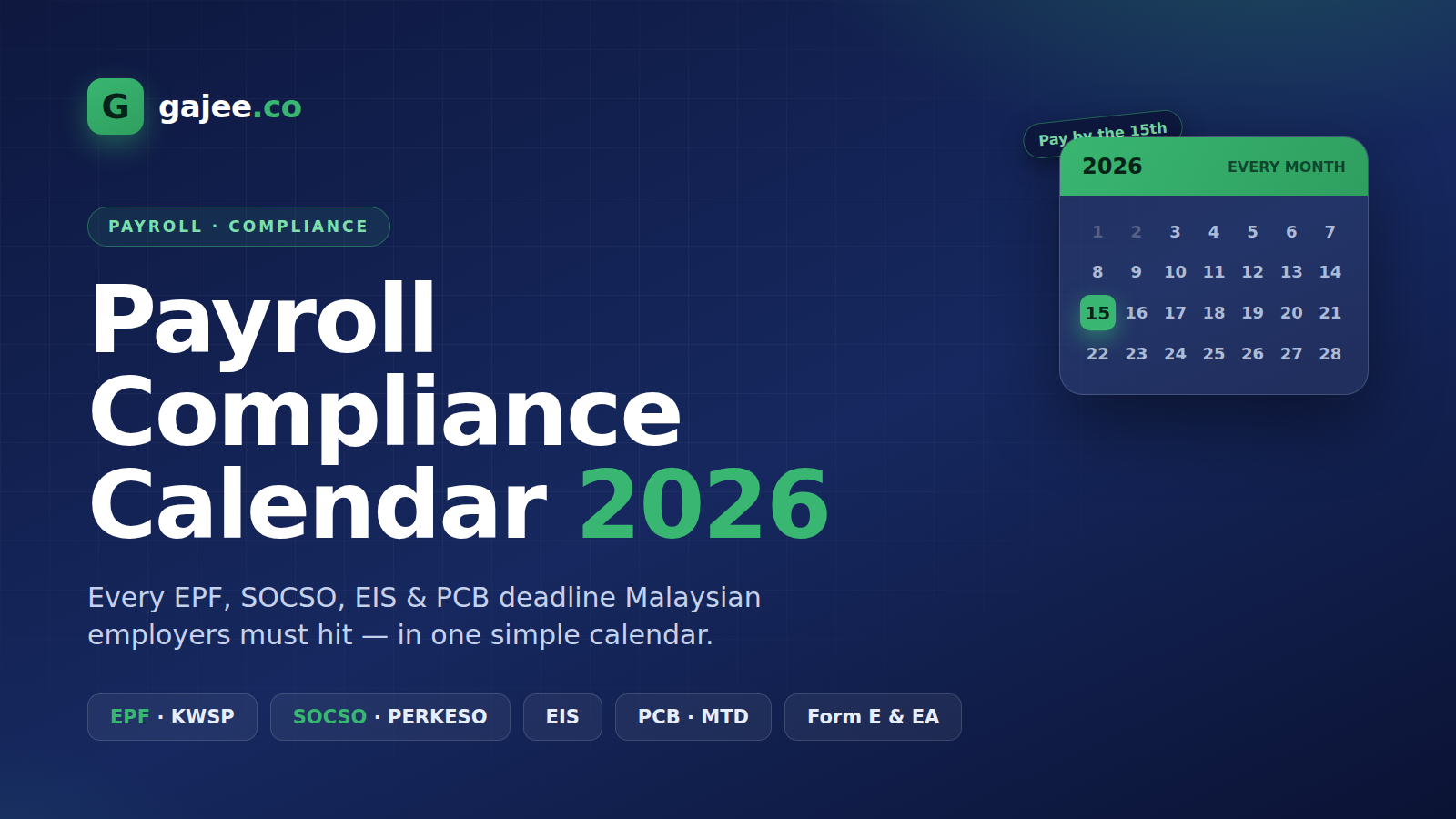
Almost every recurring statutory payment is due by the 15th of the following month. Run December's payroll? Everything below is due by 15 January. Miss the 15th and late charges start accruing immediately.
- EPF (KWSP) — employee and employer contributions. Standard rates are 11% employee, and 13% employer for wages up to RM5,000 (12% above RM5,000).
- SOCSO (PERKESO) — the Employment Injury and Invalidity schemes, roughly 1.75% employer and 0.5% employee, up to the current wage ceiling.
- EIS / SIP — Employment Insurance System, 0.2% employer and 0.2% employee.
- PCB / MTD (LHDN) — Monthly Tax Deduction withheld from taxable employees, remitted to Lembaga Hasil Dalam Negeri.
- HRD Corp levy — if you are a registered employer, the 1% (or 0.5%) levy on wages is also due by the 15th.
One date, five payments. If you remit them all together on the same day each month, compliance becomes a habit instead of a scramble.
Your monthly payroll checklist
Before you close each cycle, confirm you have:
- Calculated EPF, SOCSO, EIS and PCB on the correct gross wages for every employee.
- Accounted for new joiners, leavers, unpaid leave and overtime in the same period.
- Generated the bank salary file and paid employees on time.
- Submitted and paid all five statutory contributions by the 15th.
- Issued digital payslips so every employee has a clear record.
The year-end deadlines you cannot push
Beyond the monthly rhythm, three annual obligations catch employers out — because they only come around once and they all land in the first quarter.
Form EA (CP8A) — by the last day of February
Every employee must receive their Form EA, summarising the previous year's remuneration and deductions, by 28/29 February. They need it to file their own income tax, so late EA forms create a chain reaction of frustrated staff.
Form E (Borang E) — by 31 March
This is the employer's annual return to LHDN, declaring total remuneration paid and the number of employees. The statutory deadline is 31 March, with e-Filing typically open until 30 April. Submitting Form E without the matching EA data is a common — and avoidable — source of errors.
CP58 — by 31 March (if it applies)
If you paid incentives, commissions or bonuses to agents, dealers or distributors above the threshold, you must issue a CP58 statement by 31 March. Most SMEs won't need it, but if you run a sales channel, don't forget it.
What late filing actually costs
Penalties are not theoretical. Late EPF contributions attract a dividend charge plus a late-payment charge. SOCSO and EIS impose interest on overdue amounts. Late PCB or Form E can trigger fines from LHDN, and persistent non-compliance can escalate to prosecution. For a small business, the cost of one careless month often exceeds a full year of payroll software.
How to never miss a deadline again
The employers who never get penalty letters all do the same thing: they take the dates out of human memory and put them into a system. Automated payroll applies the current statutory rates, calculates every contribution from the same source data, generates the bank file and payslips, and produces EA and E forms straight from the figures you already ran — no rebuilding spreadsheets in February.
That is exactly what Gajee.co is built to do for Malaysian SMEs. Payroll, EPF, SOCSO, EIS, PCB, attendance, leave and statutory forms all live in one place, so the 15th stops being a deadline you dread. Start free and run your next cycle with the calendar on autopilot.